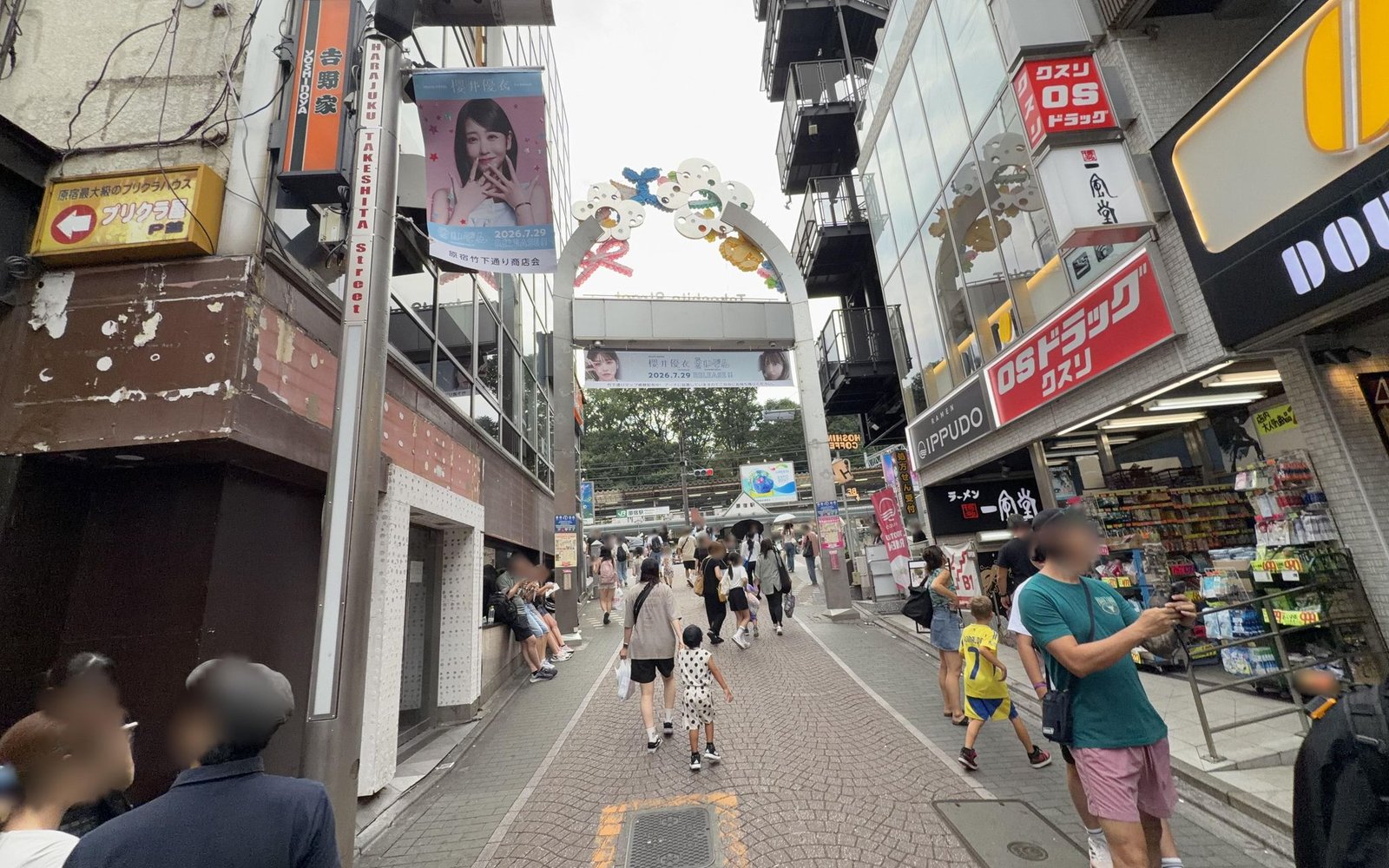
Mouth of Takeshita-dōri
We name the famous street, then turn away — but first, the corner where both the fashion and the food began.
Key facts
- Takeshita-dōri is a roughly 350-metre pedestrian street of crêpe stands, capsule-toy machines and fast fashion, directly opposite the station.
- Around 1980, “takenoko-zoku” dance troupes made it the city's youth street; they were named after Boutique Takenoko, which opened on it in 1978.
- The Harajuku crêpe — a French dessert reinvented as walk-and-eat street food — was popularised here from the mid-1970s.
Narration transcript
Here it is — the mouth of Takeshita-dori, the narrow pedestrian street packed shoulder to shoulder across from the station. Look down it: crepe stands, toy-capsule machines, racks of cheap bright fashion, a river of people. This is the Harajuku the guidebooks send you to, and it's genuinely fun. But notice what it is — loud, mainstream, and about four hundred meters of pure front.
Before we turn away from it, stand at this corner for a second, because two stories were born right here.
The first is fashion. Around nineteen-eighty, troupes of teenagers used to dance on this street every Sunday in matching outfits — the crowds called them the takenoko-zoku, the bamboo-shoot kids, after a boutique on the street. They were the first sign that Harajuku belonged to the young.
The second is appetite. The Harajuku crepe — a thin French pancake rolled into a cone, stuffed with cream and fruit, made to eat while you walk — was popularized on this very street back in the nineteen-seventies. It's still the snack everyone photographs.
Fashion and food, both invented on one loud corner, and both long since gone mainstream. That's the front. But the real inventing — the part that's still happening — moved into the quiet lanes behind it.
So we turn away from the crowd. Step off the drag and head east, into the calm. Just a block from all this noise there's a pond and a garden and a century of quiet waiting — Togo Shrine.