Omotesandō gateway — finale
Where the scruffy, invented back of Harajuku meets the polished boulevard next door.
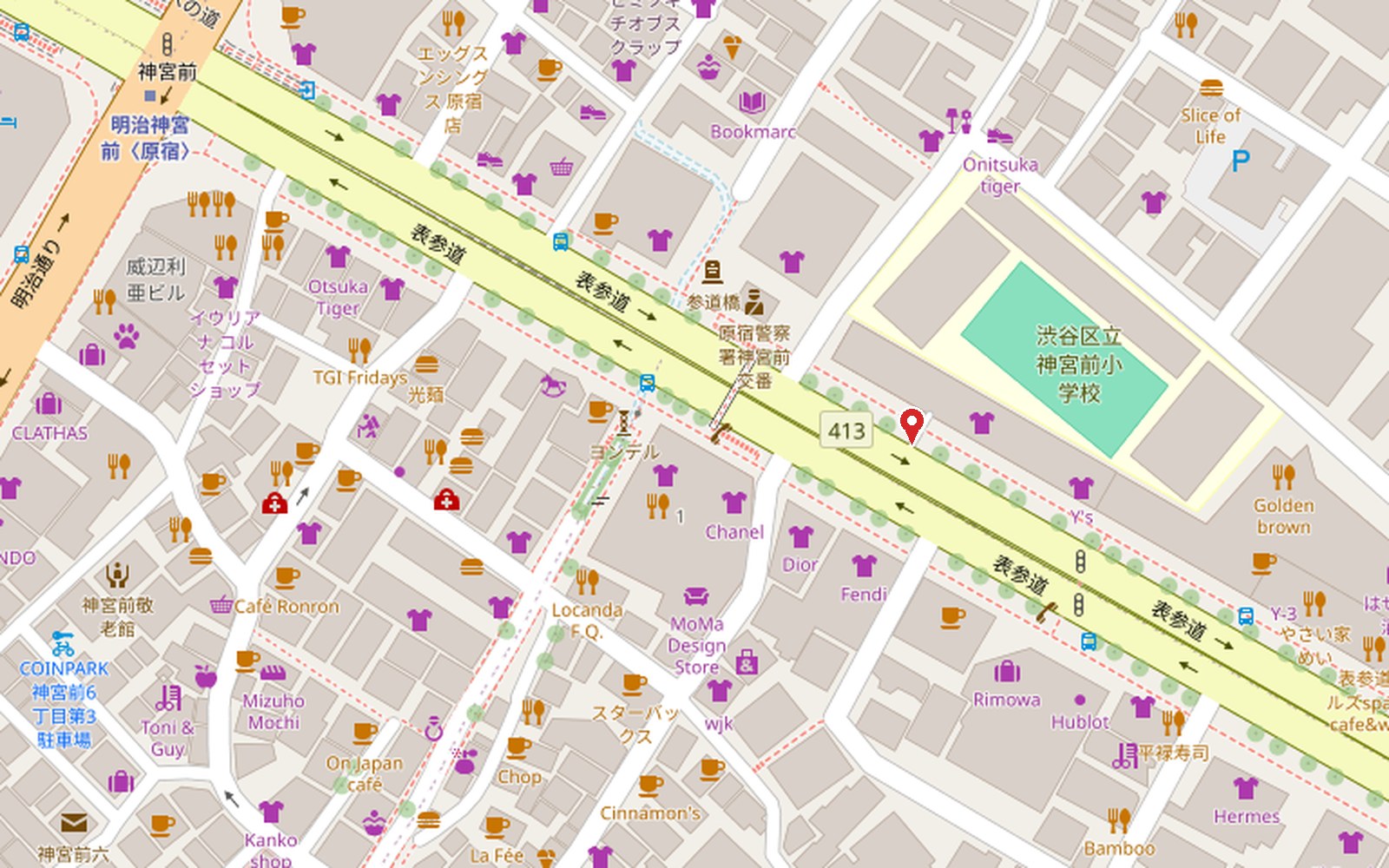
Key facts
- The walk ends where Cat Street crosses Omotesandō, the grand zelkova-lined boulevard of flagship architecture running up toward the Meiji Shrine approach.
- It closes on the contrast it opened with: the invented “back” of Harajuku meeting the polished boulevard, a few minutes' walk and a whole world apart.
- Meiji-jingūmae (~300 m) and Omotesandō (~450 m) stations are both a short walk away.
Narration transcript
And here we are, at the edge. The lane opens out, and in front of you is Omotesando — a wide, grand boulevard lined with tall zelkova trees and glittering flagship stores, sweeping up toward the approach to Meiji Shrine. After an hour in the narrow back lanes, it feels like stepping out of a secret and into a parade.
Take a second to feel that contrast, because it's exactly where we began. We started on a bridge, where the whole world watched Harajuku from the outside — the front, the spectacle, the photograph. And we walked the back: the quiet shrine, the lanes where streetwear was invented, the vintage racks, the small museum, the hidden coffee and the local kitchens, and a street that is secretly a river. All of it just a few minutes' walk from this polished boulevard, and a whole world apart from it.
That's the real Harajuku — not one street or the other, but the two of them pressed together, front and back, loud and quiet, watched and made. Most visitors only ever see the front. You just walked the part they skip.
From here, both Meiji-jingumae and Omotesando stations are a short walk away whenever you're ready to move on. But there's no rush. Linger. Have that coffee you spotted, duck down one more lane, try one more rack. The back of Harajuku rewards exactly that kind of wandering.
Thank you for walking it with me. Travel well.