Sepulveda Dam & the Basin
The dry dam that holds back the Los Angeles River — and the gorge they cut to let the freeway through the hills.
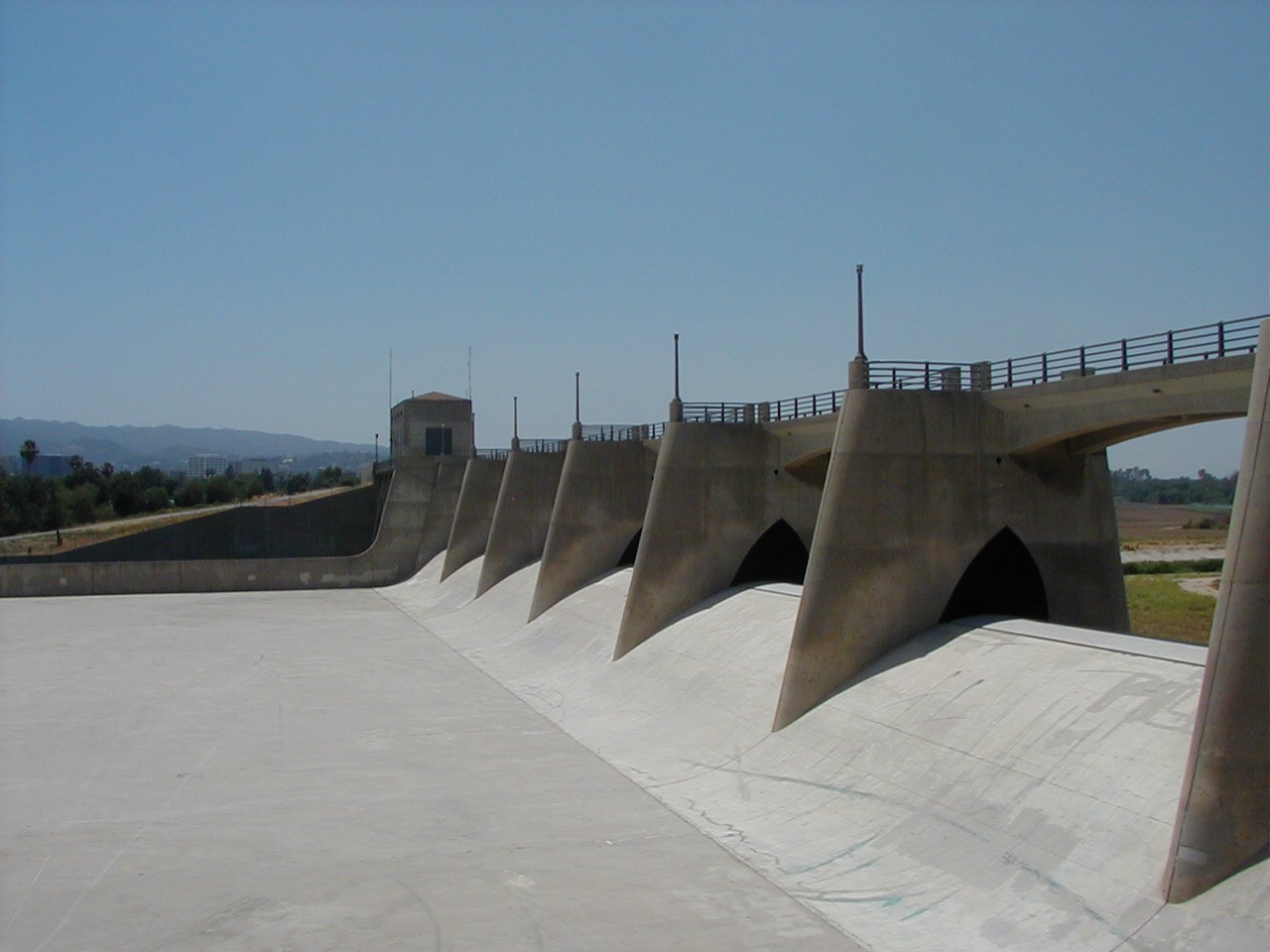
Key facts
- Sepulveda Dam was completed in 1941 by the U.S. Army Corps of Engineers for flood control on the Los Angeles River, built in response to the catastrophic 1938 Los Angeles flood.
- It is a dry (flood-control) dam — the Sepulveda Basin behind it is normally parkland and fills only in heavy storms.
- To carry the freeway over the pass, the 405 cut (begun August 1960) carved a gorge roughly 1,800 ft wide and 260 ft deep through the ridge ahead.
Narration transcript
Look to your right — that long, low concrete wall across the basin is the Sepulveda Dam. It is, oddly, a dam that is almost always dry. The Army Corps of Engineers finished it in 1941 after a brutal flood three years earlier drowned parts of Los Angeles, and its whole job is to sit here empty and wait. The wide green basin behind it — ball fields, a golf course, a wildlife reserve — is really a giant catch-basin that fills only when the Los Angeles River comes up in a storm. The rest of the time, the city gets to use the floodplain.
This is the real reason the freeway is here. The Valley behind you is tamed water; the mountains ahead are the one thing engineering couldn't just pour concrete around. So in 1960 they came at the ridge with everything they had and cut a gorge through it — eighteen hundred feet wide, two hundred and sixty feet deep — and threaded the four-oh-five through the gap.