The Getty Center
A million square feet of Italian travertine on a ridge — reached by a driverless tram, the single greatest building on the freeway.
Key facts
- The Getty Center opened to the public on December 16, 1997, designed by architect Richard Meier.
- It is clad in roughly 1.2 million square feet of travertine quarried in Italy (near Bagni di Tivoli, outside Rome).
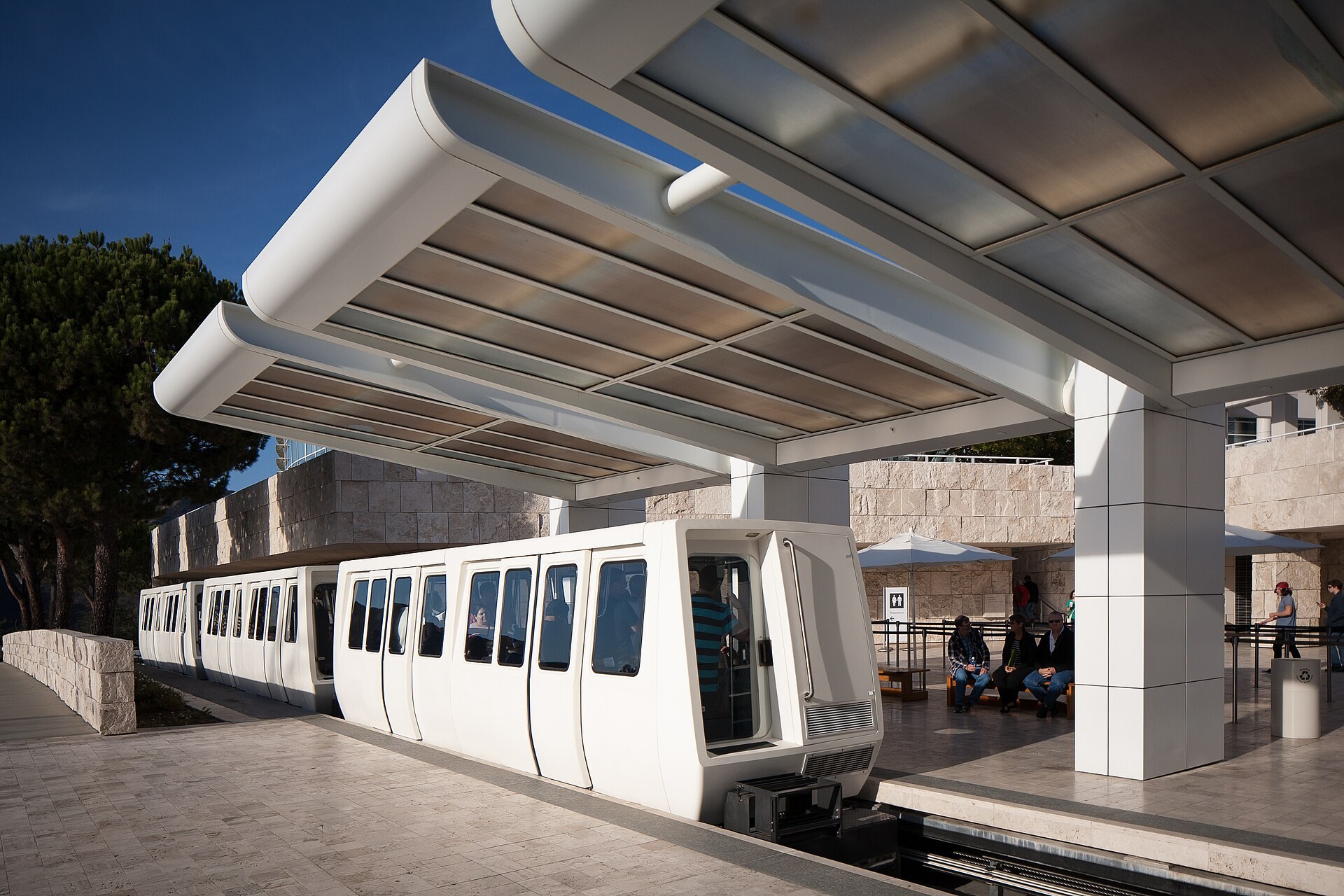
- Visitors leave their cars at the bottom and ride a driverless, cable-pulled hovertram up to the hilltop campus; the grounds include Robert Irwin's Central Garden (~134,000 sq ft).
Narration transcript
Up on the ridge to your right — that fortress of pale stone catching the light — is the Getty Center, and it is the single most important building you'll see on this whole drive. It opened in 1997, designed by Richard Meier, and it cost a fortune that only the world's richest art museum could spend. The whole thing is wrapped in Italian travertine — more than a million square feet of it, cut from the same kind of quarries near Rome that built the ancient city — and they split the blocks rough on purpose, so you can still see the fossils and the texture of the stone.
Here's the part that makes it pure Los Angeles. You don't drive up to it. You park at the bottom, down near this freeway, and a driverless tram glides you up the hillside to the top, so the climb itself becomes part of the arrival. Up there, around the white pavilions, is a living artwork — Robert Irwin's Central Garden, a ravine of plants designed as a sculpture that's never finished. A billion-dollar museum you reach like a ride, floating up off the four-oh-five.