Moulin Rouge site (Historic Westside)
The first integrated casino, designed by the same hand as the sign you started at — where the circle closes.
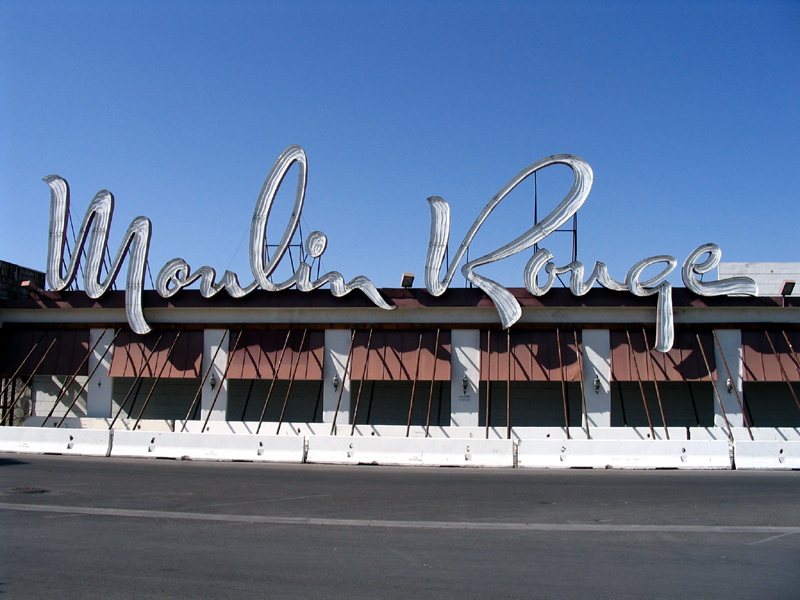
Key facts
- The Moulin Rouge opened on May 24, 1955, as the first racially integrated hotel-casino in Las Vegas; boxing champion Joe Louis was a greeter and part-owner, it made the cover of Life magazine, and it closed within months.
- For decades the Las Vegas Strip was rigidly segregated — Black performers who headlined the showrooms were barred from the hotels and casino floors, leading activists to call the city “the Mississippi of the West”; the 1960 Moulin Rouge Agreement, negotiated at the site, desegregated the Strip's resorts.
- The Moulin Rouge's neon sign was designed by Betty Willis — the same designer as the “Welcome to Fabulous Las Vegas” sign at the start of this tour.
- The abandoned Moulin Rouge building was damaged by fires in 2003 and 2009 and later demolished; the site has remained largely vacant, awaiting redevelopment.
Narration transcript
On your right, on West Bonanza, is a mostly empty lot — and it may be the most important ground on this entire tour. This was the Moulin Rouge, and when it opened on the twenty-fourth of May, 1955, it did something no casino in Las Vegas had ever done: it welcomed everyone. It was the city's first racially integrated hotel-casino. The boxing champion Joe Louis greeted guests at the door as a part-owner, it landed on the cover of Life magazine, and for a few glittering months it was the hottest room in town — where the Strip's Black headliners could finally play, and stay, and gamble.
That mattered because of what surrounded it. For decades, Las Vegas was rigidly segregated — Black performers who sold out the Strip's biggest showrooms were barred from sleeping in those same hotels or setting foot on their casino floors, a colour line so hard that activists called this city the Mississippi of the West. In 1960, at this very site, civil-rights leaders and casino owners signed the Moulin Rouge Agreement, which desegregated the resorts up the Boulevard.
And here is where our circle closes. The neon sign that once stood over the Moulin Rouge was designed by Betty Willis — the very same woman who designed the “Welcome to Fabulous Las Vegas” sign where you started, an hour and thirteen miles ago. The same hand lit both ends of this drive. The building burned in 2003 and again in 2009 and was cleared away, and the lot now waits, like so much of this city, for whatever it reinvents into next. Reinvention, one last time — the only constant.
That's the tour. Thank you for driving Las Vegas with me. To get back: Bonanza Road east returns you to Las Vegas Boulevard and downtown in about five minutes. For the Strip or the airport, head west on Bonanza to Martin Luther King Boulevard, then south to the Interstate 15 on-ramp. Whichever way you go — drive carefully, and come back soon. Which is exactly what the back of that Welcome sign says.