End of Stearns Wharf
1872: the wharf that ended the town's isolation, and the view of the whole city from the water.
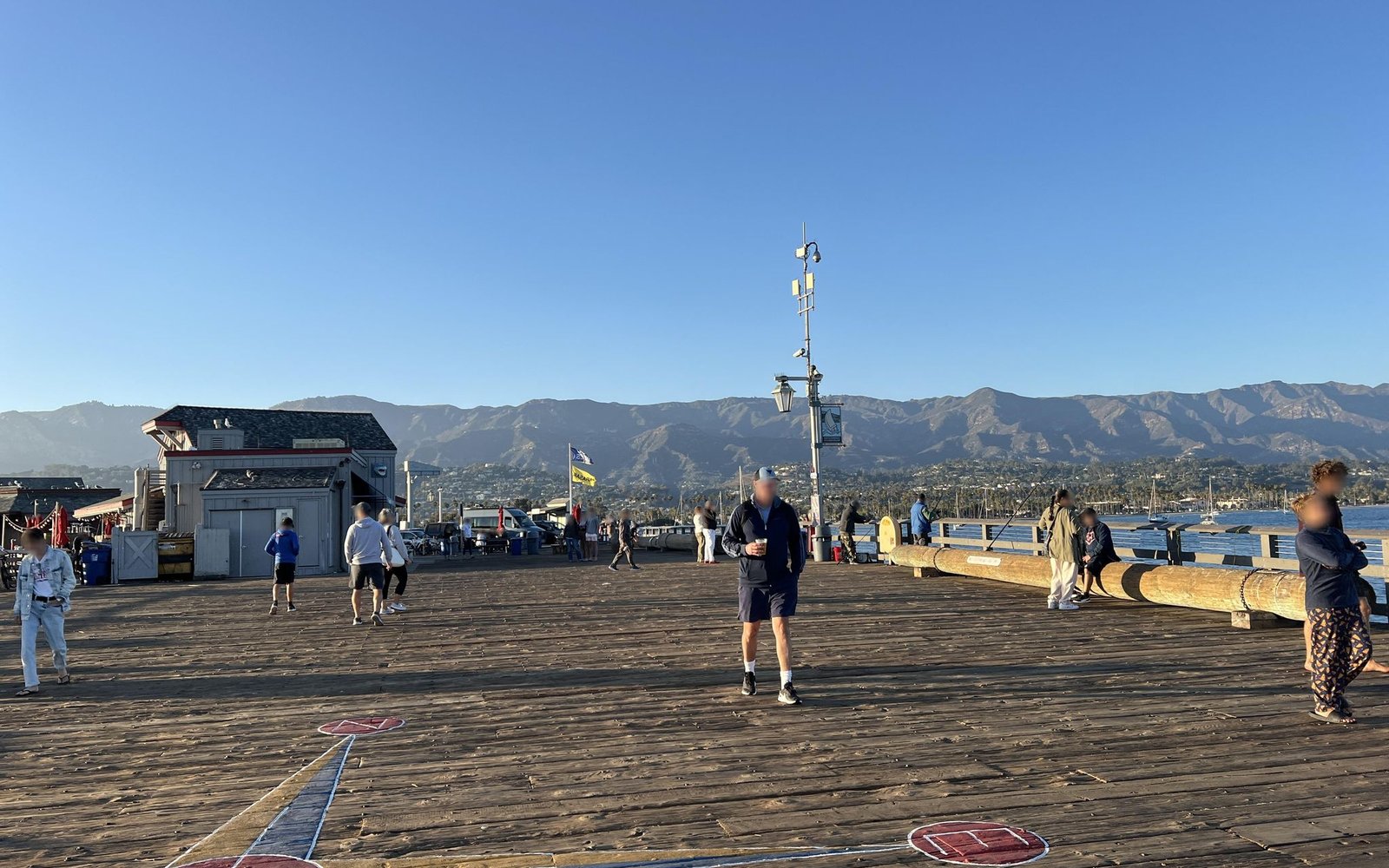
Key facts
- Stearns Wharf built 1872 by John Peck Stearns, financed largely by Col. William Welles Hollister
- Described at completion as the longest deep-water pier between Los Angeles and San Francisco
- Survived major fires in 1973 and 1998; rebuilt each time
- Santa Barbara Museum of Natural History Sea Center reopened on the wharf in 2005
- Often called the oldest working wooden wharf in California
Narration transcript
Walk all the way out to the end of the wharf, where the planks stop and there's nothing ahead but open water. Turn around. This — the whole town, red roofs stacked up against the green wall of the mountains — is the view we've been walking toward, and it's the right place to end, because you're now standing on the oldest thing on the entire tour.
Stearns Wharf was built in eighteen seventy-two. A lumberman named John Peck Stearns wanted a deep-water pier, and a cattle baron named Colonel Hollister put up most of the money, and together they built out into the channel what was then called the longest deep-water pier between Los Angeles and San Francisco. And it changed everything. Before this wharf, Santa Barbara was cut off — you reached it by ship, and you came ashore through the surf. After it, real ships could dock and unload. The town's isolation ended right here, on these pilings, in eighteen seventy-two.
Everything you just walked past came after this. The railroad in 'eighty-seven, the resort in nineteen-oh-three, the harbor in nineteen-thirty, the whole Funk Zone — all of it stands on what this wharf started. We walked the waterfront backwards, and this is the beginning of the story.
It hasn't been easy. Storms and two big fires, in nineteen seventy-three and nineteen ninety-eight, and a rebuild after each — yet here it still is, often called the oldest working wooden wharf in California, with a natural-history Sea Center out on it since two thousand five.
That's the tour. From here, the promenade, the Funk Zone, and the red-tile downtown — that's our Downtown Walk — are all just a few minutes back the way you came. Take your time. Walk it at your own pace, and enjoy Santa Barbara.