Train depot
The railroad reached town in 1887 — and the freeway that followed the tracks walled the beach off from downtown.
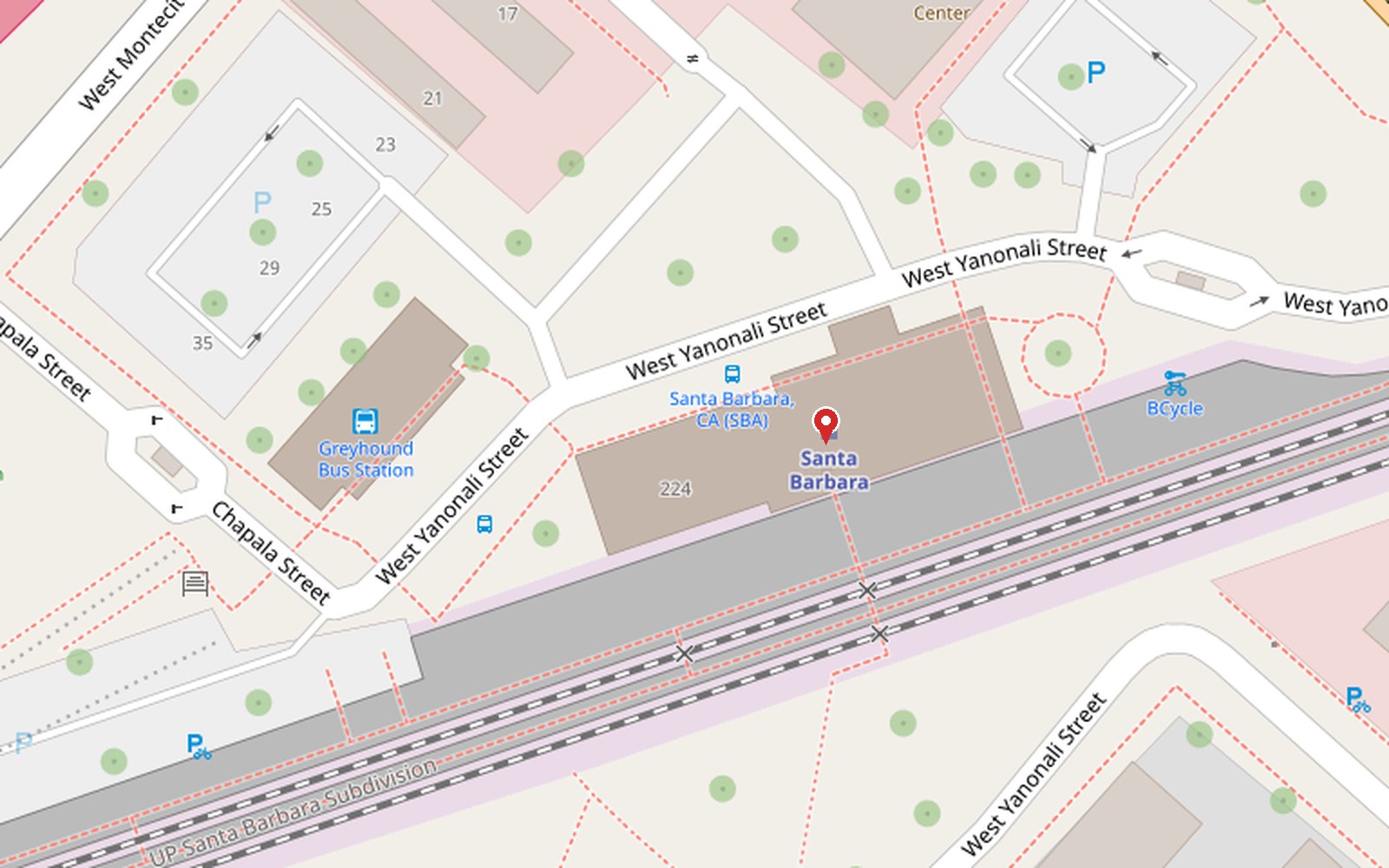
Key facts
- Southern Pacific Railroad reached Santa Barbara in 1887
- Present Mission Revival depot at 209 State St built 1905, architect Francis W. Wilson
- Through coastal rail service between Los Angeles and San Francisco completed 1901
- MOXI, the Wolf Museum of Exploration + Innovation, opened nearby in 2017
Narration transcript
Here's the train station — the low, white, red-tiled Mission Revival depot at two-oh-nine State Street. If you arrived by train today, this is where you joined us, and it's the right place to catch up, because this building is why the resort behind you could exist at all.
The railroad reached Santa Barbara in eighteen eighty-seven. That date matters more than almost any on this walk. Before it, the town was genuinely isolated — hemmed in by mountains, reachable mostly by ship, landing passengers and cargo through the surf. The Southern Pacific changed that overnight: suddenly you could step onto a train in the East and step off, days later, right here. The depot you're looking at came a bit later, in nineteen-oh-five, designed by a local architect named Francis Wilson when the tracks were straightened out.
But look at what came with the rails, because it's the quiet villain of this whole tour. Decades on, when the freeway was built, Highway 101 ran right along this rail corridor — and together, the tracks and the freeway became a wall. They cut the downtown, up the hill, off from its own beach. Everything we're walking today lives *below* that line, on the water side of the divide. Once you notice it, you can't stop noticing it — the town and its waterfront, stitched together and then split apart.
One more, over your shoulder: that bright building nearby is MOXI, a hands-on science museum, opened in twenty seventeen.
Now walk a short way west, to something that was already old when the trains arrived: a tree.