Hōzen-ji & Hōzenji Yokochō (south detour)
Step off the neon into a lantern-lit alley — and meet a Buddha so doused in prayers he's grown a coat of moss.
Key facts
- A short step south off the promenade is Hōzenji Yokochō, a narrow (about 2.7 m) stone-paved, lantern-lit alley of tiny bars and restaurants, and the temple Hōzen-ji, founded in 1637.
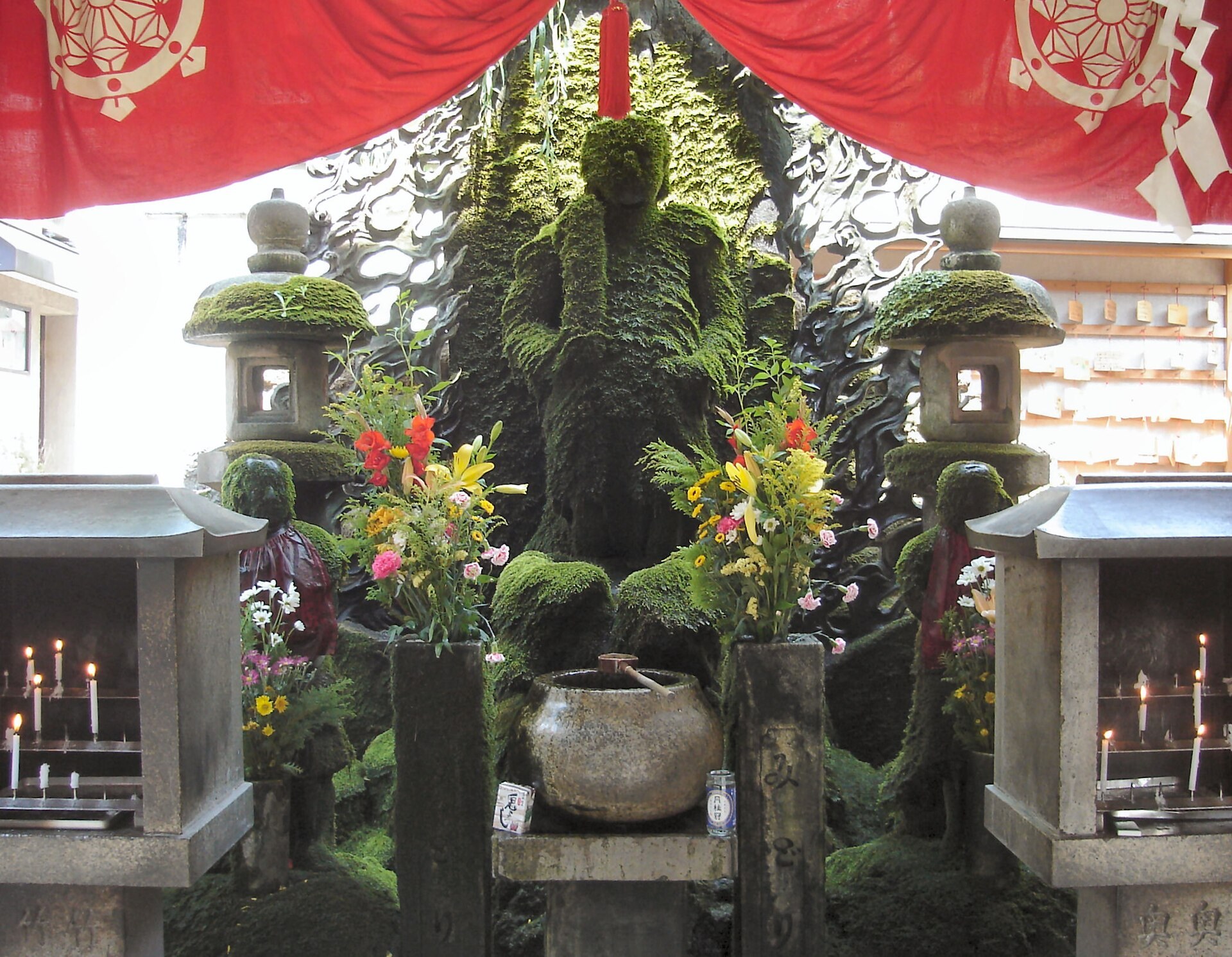
- Its famous statue is the Mizukake Fudō — a stone Fudō Myōō that worshippers splash with water as they pray; generations of water have left it covered in soft green moss.
- Most of the temple was lost in the 1945 air raids and the alley was hit again by a 2002 fire; a petition of some 300,000 signatures let it keep its original narrow width.
Narration transcript
Turn off the promenade here, to your right, and in ten steps the volume drops to almost nothing. This is Hōzenji Yokochō — a stone-paved alley barely two people wide, hung with paper lanterns, lined with tiny old bars. It's the hush at the center of the roar, and it's been here far longer than the neon.
At its heart is a little temple, Hōzen-ji, from the 1630s, and in front of it a stone statue of Fudō Myōō, the fierce guardian. Watch what people do: they ladle water over him and pray. They've been doing it for so long, and so often, that the statue has vanished under a thick green coat of moss — every inch of him soft and dripping. Throw some water, make your wish; that's the custom.
This alley is tougher than it looks. The firebombs of 1945 took most of the temple, and a fire in 2002 tore through again. Both times it came back — the second time because three hundred thousand people signed to keep it exactly this narrow. Then step back out, turn left, and we rejoin the water.