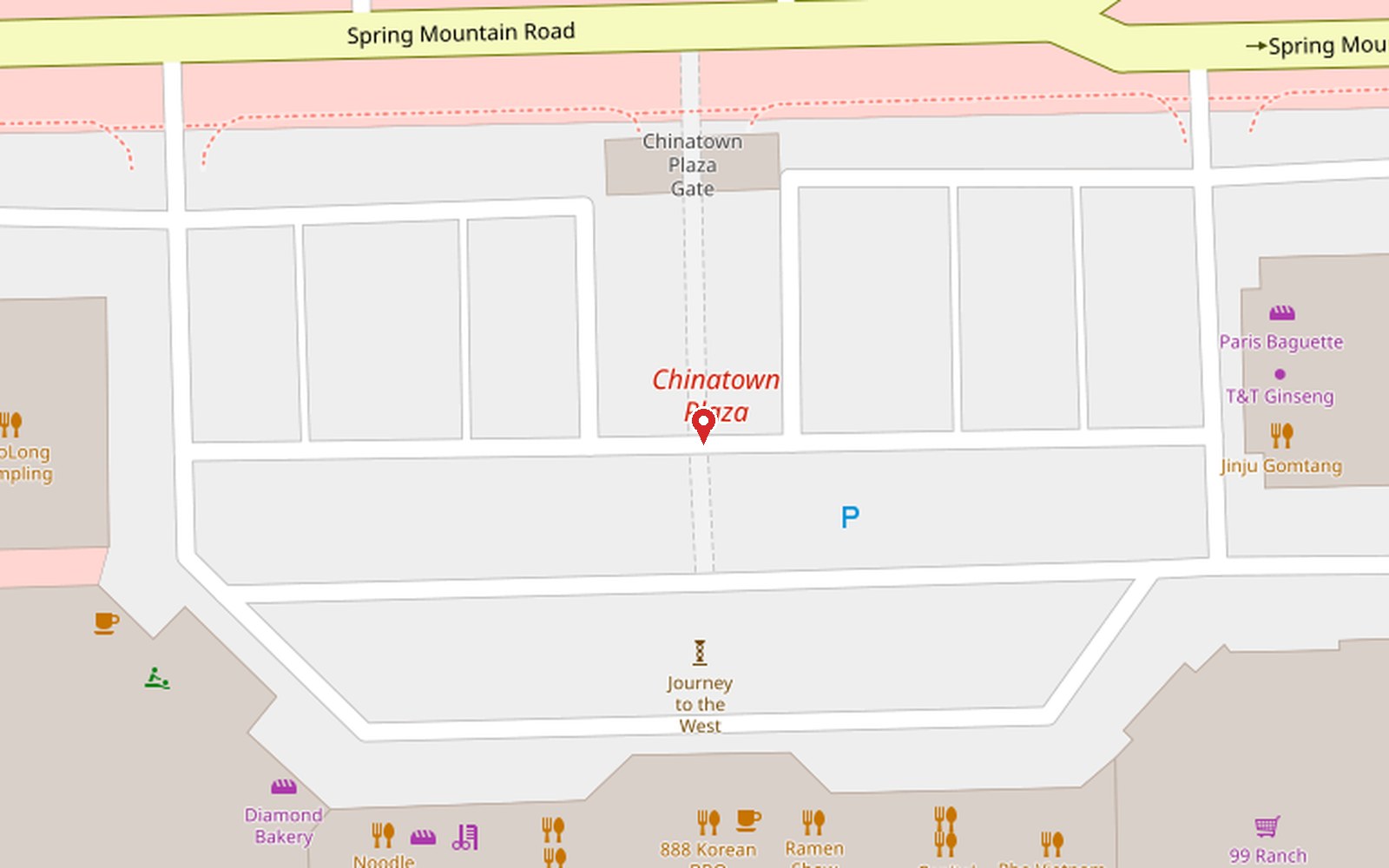
Chinatown Plaza gate & Journey to the West
America's self-declared first master-planned Chinatown — a Tang-dynasty gate over a car park, built from nothing in 1995.
Key facts
- Conceived by Taiwanese-American developer James Chih-Cheng Chen; opened in February 1995 — Chen called it “America's first master-planned Chinatown.”
- Financed by JHK Investment Group, formed with two high-school classmates, Henry Chen-Jen Hwang and K.C. Chen; the Tang-dynasty gate and two-storey plaza were designed by architect Simon Lee.
- The golden sculpture out front depicts the Journey to the West pilgrims — Tang Sanzang, the Monkey King, Pigsy and Sandy — a 16th-century Chinese novel fronting a 1990s strip-mall parking lot.
- The plaza sold in 2022 for $38 million, to buyer George Lin.
Narration transcript
Stand at the gate for a second and look up. Green-tiled eaves, upturned corners, a Tang-dynasty silhouette against the desert sky — and just beyond it, a parking lot. That contrast is the whole tour, so let's start with the secret it's hiding.
Almost every Chinatown in America is an accident of history. People arrived in the eighteen-hundreds, were pushed into a few blocks, and a neighborhood grew up around them over generations. This one is different. Las Vegas's Chinatown didn't grow — it was drawn. In 1994, a Taiwanese immigrant named James Chen looked at all the Asian tourists coming to Vegas with nowhere familiar to eat, and decided to build them somewhere. With two old high-school classmates he formed a company, bought seven acres of nothing right here, hired an architect named Simon Lee for this gate and a two-storey plaza, and opened it in February 1995. He called it “America's first master-planned Chinatown.” A Chinatown made to order.
Now look at the golden figures out front. That's not decoration — it's the pilgrims from Journey to the West, the Monkey King and his companions, a story five hundred years old, planted in front of a shopping center off a six-lane road. A little bit of imported deep history, to give a brand-new place some roots.
It worked. Within a year this plaza drew thousands of people a day, and in 2022 it sold for thirty-eight million dollars. Everything you'll see today spread out from this one corner.